Showing posts with label GM's Corner. Show all posts

Saturday, June 18, 2011

The 48 Hour Game Or How I Pulled My Shit Together and Got the Job Done


Last week I wrote about some recent adversity that had befallen my gaming group.  Out Call of Cthulhu campaign had suddenly come to a half (at least temporarily) and there was an urgent need to fill the gap.  I had two days to come up with a campaign that needed to last at least two months.  I worked through my options logically, and when I left off last time I thought I had a good idea of what genre and rules system to use.

I was wrong.  

I really tried to come up with something great to put into the fantasy genre that could be played with Hackmaster Basic or Pathfinder, but nothing would come to me.  Every time I thought I had a good idea I always ended up back at one of the other fantasy campaigns I'm currently developing which had already been deemed unsuitable for one reason or another.  I've come to a realization recently that I'm just  not very good at running any campaign but the one I am most passionate about at that time.  I just can't seem to focus and my attention just begins to wander back to the campaign I really wanted to be working on.  

Fortunately it was about this time that I got kicked out of the house.  My wife is the Maid of Honor in an upcoming wedding and bridesmaids were coming over to do bridesmaidish stuff so I had to make myself scarce.  Feeling that what I needed was inspiration I made a beeline for the nearest bookstore.  Now admittedly the store's RPG section (like most these days) was small and modest to (put it kindly) but there were still a couple of books I thought might spark my imagination.  The first book I picked up was one I had wanted to check out for a while now, Mutants & Masterminds.   It may as well have been the only book I picked up because it is the only one I ever looked at.  


It was perfect.  The game looked great, my group had wanted to play a Superhero game at Gen Con but wasn't going to get to, and perhaps most importantly all of the other ideas I had for a fantasy RPG wouldn't distract me because of the leap in genre.  I've never run nor played in a Superhero RPG, but I had a number of ideas.  I have read comic books after all.  Before I had even bought the book and returned home to my Bridesmaid free home, I had selected a simple and straightforward campaign idea that I thought would serve as a great introduction to the rules and Superhero RPGs in general.

Now it was time to buckle down and get to work.  I had already spent  some of what precious little time I had just picking a rules system and coming up with an idea for a campaign.  At this point it was time to do what needed to be done to get the game ready to play.  To do that I employed five strategies to make sure I got to where I needed to be.

#1 - Cutting Corners
Normally I don't advice cutting corners.  It's a shoddy thing to do that can some times ruin a game or a setting, but early on I decided it was a necessary evil.   I cut corners in a number of ways, but the two major ones were with the Pre-Generated characters I made for everyone, and the map I used for the games' setting, Empire City.

Mutants & Masterminds offers a number of templates for characters that serve as a great starting off point and I took advantage of those by giving each of the four PCs one of those templates.  Lowering their power level meant more work than I initially had thought, but in the end cutting this corner took much less time than building the character from scratch.

As for the map of the game, as much as I wanted to build a city map from scatch I just didn't have time.  So I cut a massive corner by taking an old map of Chicago and modifying it.  The map that I came out with looked pretty good, though when it shifted to gray scale to be printed it lost some of its detail.  Color wasn't really an option as the printer allows for massive printing (the map is 3ft by 4ft) but only in black and white.


#2 - Relying on Technology
Unlike Cutting corners I fully advise taking advantage of technology to save time in any game.  The first way that I did this was to purchase Hero Lab.  Now it might not look like much, but believe me this is a pretty cool program.  The one problem I have with it is how expensive it is.  If one were to get all the games offered, and there are several, with the base program then I wouldn't have a problem with it, but that isn't the case.  When you buy the program ($30) you get a single rules system.  Oh well, I needed it.

 
With the help of Hero Lab I was able to make the four pre-gens I needed, and could be sure that each was balanced and within the confines of the rules.  M&M can be very tricky in this last regard so that alone with a huge help.  Hero Lab also creates it's own character sheets for each player which is also cool.
 

Those sheets have a spot for a portrait for each character which was something I really wanted to do.  I once again took advantage to make this happen.  I used HeroMachine 3 to quickly and effectively create character portraits for each of our heroes.  Each had its own unique look which spoke to their powers and personality, and helped to introduce each player to the character that they would be playing. 


#3 - Not Getting Fancy
There were a number of cool ideas that I had or cool things that I wanted to do that just weren't possible in the limited time I had.  For example, normally I favor complex with layers of intrigue, but given the short length of the game, the limited time I had for preparation, and the fact that everyone was was learning a new rules system, I thought it was best not to get too fancy.  I created a fairly basic and straightforward Superhero plot in which the heroes battle a number of Super Villains on their way to the climactic conclusion.  Getting fancy can be a sure road to defeat when you are in a time crunch.  Get the job done simply and effectively and your players will be grateful for the game that you put together; spend all your time on a cool but possibly unnecessary idea and you'll be explaining to a group of angry and disappointed players why you had to cancel the session. 

#4 - Surprise!
I love surprises.  I think they are a fun way to get everyone off balance and excited about what is coming.  To that end I never told the group that we would be playing Mutants & Masterminds.  When they arrived everyone expected the same old thing, and no one was too exited about the game.  When I handed out the folders with their characters and set up my M&M GM screen momentary confusion gave way to excitement.  As I mentioned earlier, we had really wanted to play a Superhero RPG at Gen Con this year, but were unable to get into one.  It was a nice surprise that got everyone into a good mood and ready to have a good time.


#5 - Relax and Have Fun
In the end number five is the simplest and most important one.  You won't have finished everything you wanted to finish.  There will be things that you wish you could have done a better job on.  In the end you have what you have and you have to make the most of it.  When I sat down at the table I wasn't wondering if what I had would be enough, but thinking about how much fun the night was going to be.  As it turned out I was right.  The first night went really well with the PCs defeating the Villain and rescuing the hostages. 


Sunday, May 15, 2011

Lead Your Players Not Into Temptation


I've been thinking recently that I'd love for a way to tie religion into the Alignment system in my Caliburn setting. The battle between law and chaos in the wake of the King's death is a large setting wide conflict, but on a smaller and more personal scale it is the battle between good and evil that plays a much more important role. Obviously no one, in the real world or a fictional setting, is perfect.  We each have our vices and our virtues.  To emphasis this fact, and to track each for the PCs, I've made a Temptation Mat.

This is kind of a rough draft of the Seraphist version (A religion that blends of several real world faiths and includes many Judeo-Christian beliefs and values) which pits the Seven Deadly Sins against the Seven Heavenly Virtues on a sliding scale.  At the beginning of the game each player will be given thirty five points that they are allowed to assign to one of the seven scales.  Since the starting point for each scale is the -5 spot you could either start with a totally blank slate (all Zeros) or you can have some virtues and some vices. 

During play the scales with shift depending upon the actions of the character.  If a character murdered someone who slighted him his Patience/Wrath would slide a point toward the Wrath side.  If a character gave a poor stranded man his horse his Charity/Greed would slide a point toward Charity.  Only significant events or a multitude of smaller events would result in a shift. 


Wednesday, April 27, 2011

EVERY Monster from the Monster Manual?!


I was an RPG forum the other day and I came across a guy talking about how it was "unfair" that his DM didn't include every monster in the Monster Manual.  My head very nearly exploded.  His argument essentially boiled down to the fact that the Monster Manual is a Core Book and everything in the Core books must be included.

The ridiculousness of this is just staggering so really take a minute to let that one soak in.

Thankfully the fact that this particular player was taking this bullshit complaint to a message board meant that the DM did the right thing and rejected the players assertion that all monsters should be included.  I'm going to go a step further and say that all monsters should NOT be included.  

Depending on edition you are talking about hundreds of monsters, some as ridiculous as this guy.


That is a Giff.  Yes, it is a Hippo-Man with a gun.  


But aside from the really stupid monsters one can find in the core Monster book (to say nothing of the plethora that can be found in the books beyond) you have to deal with over-saturation, unnecessary additions, overlaps, and monsters that are just flat out of place in your campaign world.  

Gamemaster often spend countless hours meticulously crafting a world from their imagination.  They consider a whole host of factors often spanning thousands of years of history.  Those who go to that level of effort do themselves a disservice by forcing every single monster in the core books just to appease a player.  I'm certainly not saying that you couldn't craft a world that fit all of these monsters, but given creatures like the Giff and the Shedu (seen to the right) that is a tall order.

Monsters are an important part of the world that you as a Gamemaster build and run.  Don't just throw one in on a whim and don't try to fit too many varieties in.  Doing so can be counter effective in your quest to create a rich fantasy setting. 

Wednesday, April 20, 2011

Alternate Ability Score Generation 2


I talked previously about coming across an ability score generation table based on percentages rather than a 3d6 or 4d6 roll.  One of the principal things about this method that intrigues me is the great degree of flexibility it offers.  I made an initial attempt at what at graphing the altered probabilities of the various stats which looked like this:


What I really wanted to do from there was create graphs for each individual ethnic group Caliburn game to see what that might look like.  I used a bar graph this time since the line graph was getting a little hard to read.  Here is a look at that attempt...


A lot more tweaking is going to be required before finalizing these, but I think they are a step in the right direction.  I think I want to go even further in making each group's stat probabilities unique, reflecting the different circumstances in climate, technology, and genetics that each group sees. I also need to complete a graph for the fifth ethnic group, the Prydainians who I left out.  Oops!

Monday, April 11, 2011

Alternate Ability Score Generation


There are a lot of ways to figure out a characters ability scores.  If you are old school then you probably use the first method, rolling 3d6 (Probably in order, though some generous DMs allow for arranging to taste).  If you are more new school you probably roll 4d6 and arrange them however you want.  A third method that has become popular in the last few years is point-buy, where you get a pool and invest the points from your pool into your various stats. 

Personally I've used the first two methods and always found them to work well.  I don't, and I don't think I ever will, play with point-buy.  It just lends itself too much to cookie cutter characters.  Characters with the same class have more or less the same array of stats to accommodate a certain "build" instead of being unique. 


Another options that I recently read about on Grognardia that I was unaware of is a percentage based chart like the one used in FGU's Space Opera.  Rather than rolling the traditional d6s, player break out their percentile dice and roll on a chart that favors higher numbers.  Additionally players have a number of points they can allocate toward certain stats based on their class.  It's a very interesting approach. 


A percentage based chart really gives you an exceptional amount of flexibility.  I think that is what intrigues me most about it.   Using multiple small dice you are going to see a traditional bell curve but with this the probability curve can be whatever you want it to do.  What's more each individual statistic can have its own unique curve. 

That was what I set out to do when I made a preliminary version that I might consider using in a future campaign.  I wanted certain statistics, Constitution especially, to have a higher basement.  The idea is that with rampant disease, starvation, and other hardships anyone with less than an 8 con died off.  Other statistics, like Intelligence also see an increased minimum because those who would only be a burden to their families are often cast out and allowed to perish.  Infantcide is an accepted practice and if a father finds the baby deformed, inferior, weak, or if he suspects that he may not be the father, it is a generally accepted practice that the child would be abandon in the wood and left to die of exposure.  All of this horror and death adds up to higher minimum statistics for starting characters. 

Here is my first attempt:


It obviously needs work, and I'm not sure that I'd like to keep all of them as near normal bell shaped curves.  Again, it's the flexibility that I find intriguing about this method.  One could have a separate chart like this for each race, eliminating the need for bonuses and penalties for each race since it would be built right in.  Though I wouldn't play with the first attempt I think it warrants further attempts.  With a tweak here and a tweak there I think this method could work out really well. 

Thursday, April 07, 2011

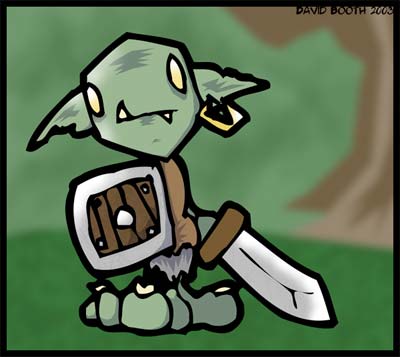
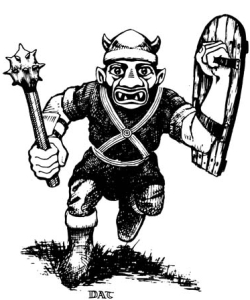
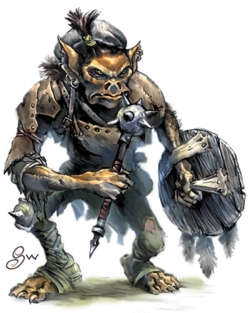
Reimagining the Goblin


Let's face it, other than the Kobold the Goblin is the low man on the totem pole.  You need a humanoid for your low level party to kick around?  Goblins fit your need perfectly.  They aren't all that dangerous, none of their abilities will frighten even a first level party.  So unless you've plan on throwing a small army of Goblins at the party, don't expect them to put up much of a fight. 

To my mind this is really kind of sad.  Goblins are a central monster in a lot of folklore, and though interpretations vary widely in those tales Goblins are usually portrayed as both scary and possessing supernatural powers.  The Goblin in D&D and other fantasy RPGs get's neither of those characteristics.  In fact they are more akin to cattle being brought to slaughter than their supernatural predecessors.  As I said, this is a damn shame.  I think it is time we got back to basics and made the Goblin a monster again and not some weakling to be kicked around with ease.

Scared?  I thought not.
Things didn't start off well for the Goblin.  In White Box D&D they warranted little more description than that they were little monsters.   Monsters evokes feelings of fear, but by describing them as little it takes away a portion of that fear and makes them seem less formidable (though obviously the fact that something is small doesn't mean it isn't dangerous).  

Later works including the Orcs of Thar and the AD&D Complete Book of Humanoids gave the option to have the Goblin as a playable race.  This kind of familiarity makes it even less likely that an adventuring party would view a small group of Goblins as a real threat, and increases the likelihood that Goblins would be looked at as just another race of people, much the way they are presented in World of Warcraft.   This isn't what we are trying to accomplish here.  In fact, it's quite the opposite.  We want to make the Goblins monstrous, to dehumanize them to a point where one wouldn't stop to chat with a Goblin, they would either run like hell or try to kill it before it killed them.

We get no help in our quest from second edition.  Hell they also present an option to play a Goblin as a PC in the Player's Option: Skills & Powers book.  Third edition humanizes Goblins even more and makes them an even less formidable threat to a party, and 4e goes even further.

So it seems we will get no help from D&D on this.  It looks like we are on our own.  In my mind that isn't necessarily a bad thing.  I think monsters are one of the things that GMs are least likely to put some of themselves into.  They buy the Monster Manual and pick monster out of the book and plop them right into their games as is.  Despite coming up with their own campaign setting, their own adventures, and their own NPCs, GMs will just use generic monsters time after time.  I think this is a habit we as Gamemasters need to break.  We put too much of ourselves games to shortchange them by using the same old creatures time after time.

Silly tinkerer Goblins?  No thanks.
Just to give an example of the same old monsters getting stale let me tell you a story about my own gaming group.  For years and years we played only 3rd edition D&D, whoever ran the game used only monsters from the Monster Manual (Usually just the first one and not the four ridiculous ones that came after) and eventually everyone became very familiar with all of the "usual suspects" like Goblins.  One of our members, Bear, seemed to know the MM backward and forward and would point certainly facts about the monsters that would drive other members of the group (especially The Professor) out of their minds.  He wasn't doing it on purpose; for him it was just a reflex action.  He had been fighting the same monsters so long that he knew them inside out.

When we switched the new edition of Hackmaster it was like hitting the reset button.  Goblin stats were different and no one was all that familiar with them, but they still seemed to be Goblins in most of the same respects.  They were still the same cowardly miniature creatures that we had seen in D&D, though the insane damage dice in conjunction with the exploding dice (called penetration dice) that Hackmaster uses meant that they were far more dangerous.  That's half way there, but the Goblins still acted much as regular humans do, not in a kind of monstrous way divorced from human understanding.  So even Hackmaster isn't going to get us where we need to be, it's time to branch out on our own and create a whole new breed of Goblin.


The 1st Ed. Goblin
Let's recap our goals for this little project:

  1. Unfamiliar - Familiarity doesn't only breed contempt, it breeds comfort and that leads to a lack of fear which is something we would like the party to feel.  Goblins are monsters and monsters should be scary.
  2. Dehumanized - Goblins that act like humans basically are human and their differences are more or less cosmetic.  I have no interest in rehashing the moral dilemmas that come with basically seeking genocide against a race because their skin is different.  Those kinds of ideas have been done to death, see  Paladin and the Orc babies for details.  These Goblins should be treated as less than human because they are less than human, no moral dilemmas about it. 
  3. Dangerous - I'm aiming to make a Goblin the equal of a Dragon, but I want them to pose a danger to the party.  As these Goblins are being made with Hackmaster in mind, this shouldn't be too difficult.  The penetration dice make you wince when you get hit with even the lowly dagger (2d4p damage).
  4. Supernatural - These are monsters after all, so I want their origins to be supernatural.  Again, I'm looking for them to be outside of the natural world and apart from humanity.  
  5. Powers - In Folklore Goblins have powers.  In D&D the Goblin's most effective power and running  away screaming (sometimes called the French power).  Ironically, even at this Goblins are hopeless as their short legs usually mean they get caught and butchered anyway.   So the aim here is to give them some powers beyond the mortal man that make them more dangerous, versatile, and unpredictable than the run of the mill RPG Goblin.  
  6. Balanced -While balance isn't our primary objective (See Game Balance & the Conformist Utopia) it is something to be considered.  We want our party to be challenged by Goblins not wiped off the face of the earth.  They should be dangerous, but not too dangerous.

A little more mean looking, but still not quite it
With our objectives clear we are ready to proceed with our Re-imagining of the Goblin.  First we should considered the Goblins origins.  The major religion of the campaign I want to use this Goblin in his a strong religious element to it that is a fusion of several real world religions including Judeo-Christian elements such as demonology.  I think setting the Goblins roots somewhere in that Demonology could be the beginnings of a great Goblin.

How about this?  ...The very first Goblins were unbaptized children of early man who were led into temptation by Demons.  They were lured away from their families to caverns which led deep under the earth.  Once there the Demons tore out their unprotected souls and gave their bodies over to lesser demonic entities for possession.  The Goblins then were left on their own to multiply by abducting other children in the dead of night and carrying them off to lairs beneath the earth where they practice their dark ritual and create more of their kin. 

I like it.  It really fits the campaign setting, piggybacks off of real world folklore, and fulfills goal #2 to dehumanize the Goblins.  Now they aren't human or any other race of being they are the bodies of children that have been taken over by Demons.

Though their bodies were originally human they are now warped and deformed past recognition.  Their skin has become a sickly gray/green color, their eyes a solid dark gray near black.  They have razor shape teeth much like the way Demons are depicted in Renaissance art and they have elongated claw like hands with razor sharp talons on the end.  These natural weapons help to make the Goblins dangerous and thus fulfill #3.  The fact that they don't use forged weapons also helps with #2 as people would wonder where they got weapons if all Goblins were seen to carry them around.  Bite and Claw attacks will work well and I think damage somewhere between a dagger (2d4p) and a short sword (2d6p) will work perfectly.

We have already made the Goblins Supernatural (#4) by making their origins tied with Demons.  We can go further, and fulfill #5 (Powers) by giving the Goblins some supernatural abilities.  First to make them creepier I think I'll give them the ability to sound like the innocent children they were made from.  So an unsuspecting party might hear children crying or calling our for help only to find they they have been set up by Goblins.  Secondly, since I don't think that leaving dead Goblin bodies lying around is conducive to goal #1 (Unfamiliar) we will have their bodies melt into a viscus liquid after they die.  The liquid will seep back into the ground returning from whence the Goblin came.  Traces of the liquid might be left on the weapons used to slay the Goblins and I think the liquid should be slightly corrosive which could lead to weapon damage.  Goblin Ichor will be a potentially powerful component for spells and potions, making saving some before it seeps into the ground a valuable, if perhaps hazardous, venture. Finally, as these Goblins are creatures of darkness they would never willingly enter light of any kind.  A party holding a light source is sure to hold Goblins at bay (#6  - Balance) but Goblins have the ability to dampen and even completely suppress smaller lights.  For example, a party carrying a torch encounters three Goblins.  Kept at bay, the Goblins remain on the outer fringes of the torch light but slowly the torch light dims until it is the light of a candle.  After a few moments four more Goblins join the original three and the torch goes out completely.  Now the party is in trouble.  Alternately if a Mage is in the group and is using his magic to create light he may find the power of his spell fading as the group encounters Goblins.  The more join the fray the more difficult it is for him to keep his spell shedding light (In game terms he needs to keep pumping spell points into the light spell to keep it active).  Clerics might have to win constant turn checks to their any magical light they are producing shedding light.  The party might just find itself in a precarious position, fighting in the darkness against creatures born of darkness, all because of a simple supernatural ability. 

Scared now?  You better be!
Already we have worked on the six goals stated above and have a cool, unique Goblin who poses a significant threat to the party and who has a cool origin story steeped in campaign lore.  The Goblin is a classic and iconic creature, but it can be versatile as well.  There is nothing wrong with the standard Goblin if that is what you like and fits in your game, but if it doesn't it only takes a little work and consideration of the six above points for you to have a custom Goblin with an air of mystery and danger to challenge your players and shatter their expectations when they come across one.  

Tuesday, March 29, 2011

Contemplating Character Creation

 
I was reading a great article the other day on the Big Ball of No Fun that discussed the idea of GMs making Characters for his players and it really got me contemplating character creation in general.  

The idea of the GM creating characters for his players isn't a new idea.  Pre-Generated characters have been around for quite a while, and are the norm for one shots and convention games.  Still, the idea of a GM making a player's character for an ongoing campaign is something of a taboo one and I'd say the vast majority of players would be fervently against it.  My question is, should they be?

Given how busy people are these days and how little time many of Gamers have to play, should they turn up their nose at the opportunity to have a character tailored made for the campaign and the ability to dive right in and play?  
I can you tell you that had you asked me last year I would have told you that only under very specific circumstances should a GM furnish a play with a pre-made character.  The list of those circumstances would have been very short, likely limited to convention game, one shot, trial players, etc.  That was until my group's last camping trip when we played an Aces & Eights game with some really amazing pre-gens that the Professor, who was running the game, who supplied us with.  Everyone enjoyed their characters so much that it really shifted the way we all viewed pre-gens in general. 

Now these weren't blind pre-gens, each gave the GM an indication of what type of character we wanted to play.  We all wrote a little blurb, no more than a sentence or two, and emailed it to the professor giving a rough outline of characters we were interested in.  As an example, here is what I sent:
  1. A bounty hunter with mercenary sensibilities who looks to get the job done  by any means necessary.
  2. A hot headed, duel pistol slinging, up and coming, young gunfighter who is looking to carve himself out a place is western lore.
  3. A naive law man with a black and white world view, a low tolerances for lawlessness and bullshit, and an itchy trigger finger.

Using these the GM created two pre-generated characters and I was given the option to play either (and to play the other one should the worst happen).  I opted for the first one, a Bounty Hunter named Augustus Bachman.  He had everything I had imagined right down to his double barrel shotgun.  More importantly he had a definite place in the campaign world and the story that was to unfold. 

This added ability on the part of the GM to create a more compact game is a serious mark in the pros column of this issue.  With a firm knowledge of who each of the PCs is, what they can do, where they have come from, and where they want to go, the GM need not worry so much about flexibility and  having  the ability to react to a group of adventurers with widely different motivations.  Still the cons column can't be ignored, and under there you'll find things like stifled player creativity and a lack of player investment in the game.  

So I think the conclusion is that pre-gens can be a great way to go, but they aren't always a great way to go.  Making the right decision on this issue, like so many others when GMing, comes down to knowing one thing... knowing your players.  Maybe some of them would welcome the opportunity to play a tailor made character while others would like the chance to roll and make their own character.  Don't be afraid to offer and you might be surprised, first when your player accepts, and then when they fall in love with the character and everything works out great.  

My plan in the future is to offer three options for PC creation.  My group has a diverse set of preferences so I've found that offering multiple options works fairly well. 

The first option will be to create a character as normal.  They will roll the stats as is normal for the system, make purchases for skills, feats, etc, and finally create a back story for their character.  Creating a written backstory for some players, no matter how short, is a task that makes them moan and shake their fists.  For that reason I'm going to offer two options that don't require one. 

The second option is a tailor made pre-generated character.  I do all the work  (with a sentence or two of guidance from the player as above), roll all the dice, purchase all skills, feats, talents, etc that I feel fit the character.  Finally I supply the player with a backstory and description of their character.  Those who have little to no time prior to the game are the one's likely to take the option and to be grateful for it. 

The final option is a Hybrid option.  I create about 75% of the character, all the base stats, the majority of the skills and other things, but leave some wiggle room for the player to customize the character.  As far as a backstory he will be given more of an outline and allowed to make additions, subtractions, and alterations to it before the start of play.  This method allows for some ownership and creativity form the player while taking a very small amount of time and allowing him to dive right in with a character built for the campaign that are about to enter. 

I think pre-gens are not something to be avoided even by the most experience of groups.  Rather they are a great tool that can allow someone with a limited amount of time an ideal character to plug into a game right away and get to playing and having fun.  Pre-made character can be just to fun to play as those made by a player's own hand.  It just takes a little work from the GM and a little communication from the player.

I'd be eager to hear from anyone out there who has had a memorable experience, either positive or negative, with GM made PCs.  What did you enjoy about it or what would you like to have seen done differently? 


Tuesday, March 15, 2011

Turning Bad Movies Into Great Games


Some movies are so bad that virtually nothing from them is salvageable for Gaming purposes.  Others are ones, though they are still bad, that are built on a cool premise with loads of potential.  I've recently undertaken designing a game with just such a movie as the inspiration.

The Movie:

The film in question is the 2006 movie, The Covenant.  If you haven't seen it please just take my word for it that it's bad.  If you already have seen it... well what can I say?  I'm sorry.  

To give you an idea of what the movie is about here a partial plot summary from Wikipedia:

In 1692 in the Ipswich Colony in Massachusetts, five families with magical abilities, referred to as "the Power", formed a covenant of silence to protect themselves from persecution. Four of the five bloodlines (Danvers, Parry, Garwin, and Simms) survive to this day; one family (the Putnams), lusting for more power, were banished, their bloodline disappearing without a trace until now.

The Covenant tells the story of the Sons of Ipswich, four young students at the elite Spencer Academy who are bound by their sacred ancestry. As descendants of the original families that settled in Ipswich Colony in the 17th century, the boys have all been given amazing supernatural powers. But their ability to shape-shift, defy gravity and perform superhuman feats of strength comes at a terrible cost: every time one of the Sons of Ipswich uses his magical powers, he ages prematurely, and the temptation to abuse the power makes it more addictive than any drug. What's more, life is only going to get harder for the young friends; they are given a taste of the Power at age thirteen. Then at the moment each boy turns eighteen, he will "Ascend", gaining far more potent —and addictive— powers.


Here is a look at the official trailer for the movie


The Cool Stuff:

So now you are probably saying to yourself, "This guy said the movie sucks, I saw the trailer and I really believe him, why is he wasting his time?"  The reason is because this movie is that second type of bad movies that I talked about above.  It has a premise that gave it a chance to be cool, but was torpedoed by nearly every other factor in film making.  The trick to this technique of designing games is identifying what that cool premise is, how to extract it leaving all the crap behind, and turn it into a great game. 

Let's get back to our example, The Covenant.  The core premise of this movie is that these five families (The original settlers of the Ipswich Colony) made some kind of deal with a supernatural power and were given immense power themselves.  The power comes at a price, in the movie it is premature aging but that can easily be changed.  The history of these families are firmly bound to the Salem Witch trials, another awesome thing to take away.  To protect themselves the families joined in a Covenant (hence the name of the movie) of silence to escape the persecution they encountered during the Salem Witch Trails.  This is a cool idea because it puts rules in place that the characters, who wield powerful magic, must adhere to or face serious consequences.  The movie even provides a great idea for a villain, a descendant from the 5th family who was thought to have been killed off who returns seeking power and revenge.

Already I have a really cool idea for a game, taken from a really terrible movie.  From here there is a wealth of information based on historic sources surrounding the Salem Witch Trials.  Since I don't live too far from there I could even take a ride up to Massachusetts and do some research in Salem and Ipswich in the flesh.  
I'm pretty excited about this game which I've decided to call, "The Sons of Ipswich".  It seems like a great fit for the Call of Cthulhu game system and mythology.  I'll keep you posted on my progress designing the game, in the mean time you should consider taking some core concepts that have potential from movies that squandered them and making a kick ass game from them. 

Tuesday, February 15, 2011

NPC Cards


 I wanted to share something really cool from our currant Call of Cthulhu game.  I'm not running the game, The Professor is.  He, like the rest of us, was new to the system when we began, but that has not impeded his ability to GM.  So far the game is absolutely awesome and part of it is the small things like his NPC Cards.

The concept is simple and certainly not a new one, but there is a reason this has been around for a while... It's a great idea.  The Professor's execution of the concept is flawless.  He lists pertinent information to the character like their name, nickname, and a Fraternity or Sorority if they belong to one.  Then he gives some key biographical notes like where they are from, what their major is, what clubs and/or sports they are involved in, etc.  Finally he lists character traits and events that have become clear as the PCs have interacted with them.  For example, Ruth has proved untrusting of the PCs every time they have met her, Beth has a short temper and constantly yells, and Bobby beat the crap out of Revil's character, Kenneth.  


Perhaps the most important feature of the card is the photo.  Ever one for authenticity, The Professor has gone back into archives of old yearbooks and pulled actual student photos from the late 20s.  It's a great touch that makes each NPC seem that much more real and gives each NPC card a yearbook-ish feel.  That works really well as our characters have gone to old Yearsbooks as important sources of information on various persons around campus.

One person in particular, Reginald St. Birmingham III, has been of particular interest to our characters.  Birmingham is the villain of this chapter of the story and is obviously up to some shenanigans, though our characters aren't sure of exactly what at the present time.  When investigating him we started our research (where else?) in the yearbook.   His entry provided some background information and some important clues on where to look next.    One of the characters, Charles (Doodle's character) is also from Newport and had heard of the affluent St. Birmingham family and knew what kind of business they were in, their general reputation, and where they live.  We proceeded with our investigation by looking into the activities Reggie was involved in, specifically the Bohemian Club and Sigma Phi.  While we haven't cracked the case yet, this information certainly put us on the right track.

NPC cards like this are easy to make and definitely worth the time and effort.  They help yours players connect with the various important NPCs and provide them with a quick reference guide to the pertinent facts about them.  If you are playing a CoC game, particularly one set at Miskatonic University, you will want to also follow the Professor's lead and lean heavily on old yearbooks from the 20s and 30s as a resource of both pictures and great information about the time.

Tuesday, January 11, 2011

Game Balance and the Conformist Utopia


Reducing everything down to the point where everything is mechanically identical may be balanced, but it will be just as fun as a conformist utopia. -Korjik


I came across this quote over at EnWorld.  Besides being funny, it is also absolutely true.  In my youth I always thought game balance was a good thing, something that one should strike for.  However, over the years I've come to question whether a balanced game is always a good idea.  Now I'm not saying one should throw game balance to the wind, just that balanced isn't always better.   

Take D&D as an example.  In first and second edition you have no real balance between the classes, at least not in the modern sense.  The fighter is great at the beginning, but gives up the crown fairly early on to the magic using classes.  This is further balanced out by the fact that the magic wielding classes all took far more experience to advance in level.   Yet a 18th level fighter and a 18th level wizard were not balanced against one another.  

Third edition came along and did away with differing experience table and so undertook the difficult task of balancing each class against each other each level.   At this task, they failed terribly.  That isn't to say they didn't go a great job, I'm not bashing 3rd edition here, but the classes were not all made equal.  A 12th level Wizard is orders of magnitude better than a 12th level Ranger.  Other classes were very well balanced, like the Wizard and the Sorcerer, but by and large there was a pecking order as to how powerful the classes were.  The reason they couldn't all be perfectly balanced is that they all did different things, and did them in different ways. The classes all had their own feel and their own niche within the game.  

Soon after 3.0 came 3.5.  It attempted to fix the issues in the original 3rd edition design, including some of the balance issues between the classes.  Rangers, for example got much better, but still the classes were not perfectly balanced against one another and the pecking order still was there, albeit in a slightly different order.  The jam was still in the cog, which is to say that the classes were still so widely different, and had abilities that couldn't be quantified to match each of the other classes perfectly.   
 
Enter 4th edition.  Game developers had been questing for balance for a long time now and finally come up with a way to balance all the classes almost perfectly, give them all comparable abilities.   Now I'm not saying that all the classes from 4e are the same, but they are much more similar to one another than in any other version of the game.  Each has dailies, per encounter, and once a day abilities that can be easily balanced against one another.  Now I'm not saying that 4e is perfectly balanced, but it is the closest thing to perfectly balanced that exists out there.  


WotC finally hit the mother-load of balance, finally reached the promised land it had long search for.  Hell I had been looking for it myself for a while, but now that I got to look on it, I didn't really like what I saw.  Gone was the unique feel of each class, gone was what made each of them special.  They just all felt the same, uniform, homogeneous. 

That's when I realized that the White Whale I was chasing was something of a poisoned prize.  To get balance you have to give something up, a certain amount of flavor and texture.  You have to be willing to part with the differences that make things unique and interesting.  Balance craves uniformity and consistency, and those things just aren't very interesting. 


So I am done chasing game balance as the ultimate prize.  Instead I'll keep it on the shelf with the other things.  It has it's place, but it isn't higher than a host of other factors that make up a great game.  


Saturday, November 06, 2010

The Birth of a New Campaign


As Gamemaster's we never quite know when we still stumble across a small spark that will ignite a blaze of passion and form a campaign.  The spark can be any number of things; a book, a film, a comic, or any number of other things.

My most recent spark came while I was wandering the Connecticut Renaissance Faire and came across a small camp.  The camp itself was roped off providing a single entrance.  Next to that entrance was a sign that read:


Now one of my good friends that I game with (AngryBear) loves all things German and is currently majoring in German in college.  He had planned to go with me to the Fair, but unfortunately had to work.  Wanting to show him what he was missing I sent him the picture above.  Then I wandered into the camp, curious to know more.

The Geld preparing a midday meal
Though this was only the second Renaissance Fair I have been to, but this was the single greatest thing I saw at either one. The camp was a miniature version, of course, but they had sleeping tents set up, a cook fire, a weapons rack on display, and a bunch of friendly soldiers and camp follower to answer any questions you might have.  One such gentlemen came over to ask me and my wife if we had any questions.  He may have regretted that decision later as I kept him around bombarding him with all manner of questions long after my wife had rolled her eyes and walked away.  This gentlemen, and the other members of the troupe, were a wealth of great information.  He took me over to the weapon rack and showed me all of the most common instruments of war used by the company.  I got to hold most of them and even give a couple of them a swing.  Once I was out of question the I thanked the man and took one more last look around the camp before going to find my wife, but on the way out the man stopped to let me know they were performing an arms demonstration at 3pm on the green. 

We got back in time for the demonstration which was a real blast.  These guys were very funny, passionate about the subject matter, and just a blast to watch.  Here is a short video of them doing their thing.


As we were leaving the demonstration my wife was apparently asking me some pointed questions about lunch but I didn't hear her.  The cogs were already in motion. 

Everything I had learned at that camp and at the demonstration had me convinced that a D&D game in which the PCs were part of a mercenary company would be awesome.  With a ton of historical info to draw from, as well as a number of fictional sources like The White Company and The Black Company, there are endless possibilities.   

When I got home I got started on the campaign right away.  The Mercenary company I had just learned about was a Fähnlein, so I started there.   From there I moved onto Italian mercenary companies from the late middle ages through the renaissance.  I'm still in the process of getting my hands of some books to mine for material such as Condottiere 1300-1500 Infamous Medieval Mercenaries and Medieval Solder

With a solid foundation of the subject matter, I turned my attention to my fictional company.  I made some quick decisions based on the research as far as size; 400-500 fighting men with about 600 camp followers for a total size of roughly 1,000 men women and children.   The man who led the reenactment company said that he was the younger brother of a Baron and that is how he had the funds to muster and pay for his company.  That worked perfectly for me.  So my first NPC, the leader of the company, was the younger brother of a Baron.  I decided he was the middle son of three, and through he got on very well with his younger brother, he generally disliked his older brother.  So when his father died and his older brother became Baron our Mercenary Captain took his inheritance, mustered his very own mercenary company.  I settled on the name Eldon Ventris for him, a name that speaks to his adventurous spirit.  Eldon is somewhat cold and cutthroat, but in many ways he is what the life of a mercenary has made him.  Gold is what keeps his company alive and together, so when it runs out the Company's time has run out.  His greatest goal is to see that that never happens. 

Some art I created for the campaign using Terragen and Photoshop.
I had ideas for some other NPCs, a grissled old veteran sergeant who serves as Eldon's second in command, a weary old healer who serves as the company's medic, etc.  But first I wanted to find a name for the company itself.  A lot of great names for a mercenary company have already been taken; The White Company, The Black Company, The Brave Companions, The Great Company, and a host of others.  I wanted something that spoke to Eldon's feeling that he and his men aren't the favored sons of their fathers, and are in some way outcasts.  So I settled on the name "The Black Sons."

That was about all I finished that night, but by fanning the flame immedielty I made sure that the spark that was my visit to the Das Geld Fahnlein wasn't wasted.  Instead, it is well on its way to being the foundation of a very solid campaign.  If you are lucky enough to come across your own spark, don't wait.  Get right into it or you may loose your inspiration before it comes to fruition.