Showing posts with label Legacy DnD. Show all posts

Monday, May 23, 2011

D&D Lair Assault: 4th Edition Takes Final Step to Becoming a Board Game


"The D&D Lair Assault program is designed for players looking for more complex, strategic, and highly tactical challenges. The D&D Lair Assault program is tailored to groups of players who enjoy solving tactical puzzles, optimizing characters, and using rules to their advantage. Each D&D Lair Assault challenge features complex encounters prepared in advance by the Dungeon Master.  Players are then pitted against their DM in an attempt to solve highly customized and creative challenges."

That is from here.  I found out about it at Geek Related.  Here is the official Wizards of the Coast announcement from a few days ago. 

I almost wish I hadn't read any of it.  There is so much to be disturbed about in the above statement that I won't even go into it.  I will say that I don't understand the people at WotC that are currently in charge of Dungeons & Dragons.  On the one hand they almost acknowledge that 4e is going in the wrong direction and attempt to right the course by releasing Essential.  Then on the other hand they go and release their ridiculous collectible cards and now they are doing this. 

Congratulations Wizards of the Coast you are now managing to piss off and alienate even the 4e crowd.  Maybe they figured they had pissed off fans of every other edition so they might as well go for the complete set.  Not all of those who play 4th edition are pissed of course, some really like the sound of this.  But is it really a good idea to fracture your market yet again?  It just doesn't seem like good business sense to me, but then again neither did refusing to sell old school PDFs.  

Tuesday, May 17, 2011

Coaching Dungeons & Dragons

I stopped by Wondrous Imaginings yesterday and was rewarded with one of the funniest things I have seen in quite some time.  Dungeon Bastard did a PSA about Bill Cavalier, Adventure Coach.  I could take the time to describe it to you, but I just don't have the heart to ruin it for you!

Check it out...


Thursday, April 28, 2011

Which Monster Manual?

Yesterday's Monster topic and Seth's comment about the 2nd Edition Monster Manual really got me thinking about the differences between the various editions Monster Manuals.  From edition to edition the books vary a great deal while containing most of the same core group of monsters.  So my question to you, noble reader, is which Monster Manual do you like best and why?

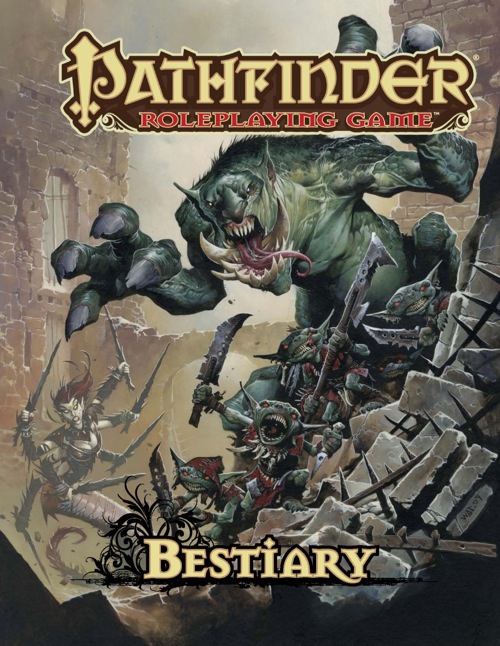
There are plenty to choose from, here are pictures of your options to jog your memory a bit.  Noted that I've included Pathfinder as many (including myself) see it as D&D 3.75, and I included two covers of the AD&D 1st edition MM because one is near and dear to my heart and the other is the one that most people owned.  


Wednesday, April 27, 2011

EVERY Monster from the Monster Manual?!


I was an RPG forum the other day and I came across a guy talking about how it was "unfair" that his DM didn't include every monster in the Monster Manual.  My head very nearly exploded.  His argument essentially boiled down to the fact that the Monster Manual is a Core Book and everything in the Core books must be included.

The ridiculousness of this is just staggering so really take a minute to let that one soak in.

Thankfully the fact that this particular player was taking this bullshit complaint to a message board meant that the DM did the right thing and rejected the players assertion that all monsters should be included.  I'm going to go a step further and say that all monsters should NOT be included.  

Depending on edition you are talking about hundreds of monsters, some as ridiculous as this guy.


That is a Giff.  Yes, it is a Hippo-Man with a gun.  


But aside from the really stupid monsters one can find in the core Monster book (to say nothing of the plethora that can be found in the books beyond) you have to deal with over-saturation, unnecessary additions, overlaps, and monsters that are just flat out of place in your campaign world.  

Gamemaster often spend countless hours meticulously crafting a world from their imagination.  They consider a whole host of factors often spanning thousands of years of history.  Those who go to that level of effort do themselves a disservice by forcing every single monster in the core books just to appease a player.  I'm certainly not saying that you couldn't craft a world that fit all of these monsters, but given creatures like the Giff and the Shedu (seen to the right) that is a tall order.

Monsters are an important part of the world that you as a Gamemaster build and run.  Don't just throw one in on a whim and don't try to fit too many varieties in.  Doing so can be counter effective in your quest to create a rich fantasy setting. 

Saturday, April 23, 2011

Gen Con 2011 Event List Is Out


Last night Gen Con released the Event list for 2011.  You can download it in the obnoxious .csv file and open in Excel, scrolling through 8171 rows trying to find what you are looking for, but my suggestion is just to use this much better website for browsing events. 

I've got to say I'm a little disappointed with the event list.  There are a couple of games I really wanted to play at the convention that just aren't available.  Aces & Eights is probably the biggest of these.  Last year there was only one game and this year none... Very disappointing.  I really wanted to play Pendragon as well, but that is also totally unavailable.  Hackmaster Basic is finally getting some love this year, so that is good, but there are no Song of Ice and Fire RPG games.  It's good to see more 1st and 2nd editon D&D games being played this year.  The two 1st edition games we played last year were a blast.  We will definitely be signing up for more of those.

Wednesday, April 13, 2011

The Banning of Dungeons & Dragons


I really thought we were far past this crap, but apparently I was wrong.  Taylor High School in Taylor, Texas has a Dungeons & Dragons Club that is now in danger of being abolished because of the School Board feels that the game, "Promites Death and Violence."

Sigh...It's like a time warp back to the 80s.  Fortunately, some more sensible people are stepping forward and attempting to get the school board to see reason.  So it looks at though there is some hope that things will have a happy ending, but it really makes you shake your head.

Thanks go out to WJ Walton of the Escapist for spreading the news about this issue.  He also made a great video (seen below) to present some of the reasons that RPGs are not only fun, but help to better people in several important way. 

Thursday, April 07, 2011

Reimagining the Goblin


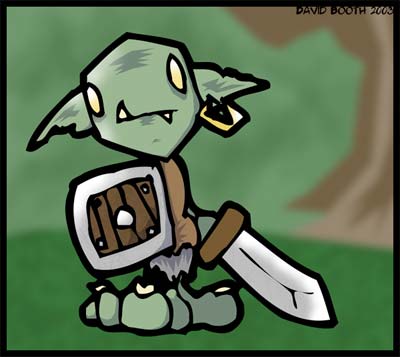
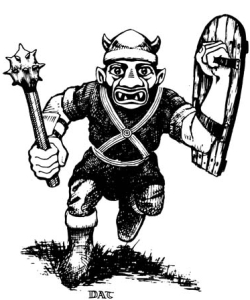
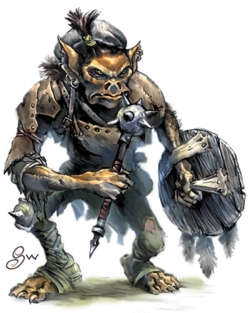
Let's face it, other than the Kobold the Goblin is the low man on the totem pole.  You need a humanoid for your low level party to kick around?  Goblins fit your need perfectly.  They aren't all that dangerous, none of their abilities will frighten even a first level party.  So unless you've plan on throwing a small army of Goblins at the party, don't expect them to put up much of a fight. 

To my mind this is really kind of sad.  Goblins are a central monster in a lot of folklore, and though interpretations vary widely in those tales Goblins are usually portrayed as both scary and possessing supernatural powers.  The Goblin in D&D and other fantasy RPGs get's neither of those characteristics.  In fact they are more akin to cattle being brought to slaughter than their supernatural predecessors.  As I said, this is a damn shame.  I think it is time we got back to basics and made the Goblin a monster again and not some weakling to be kicked around with ease.

Scared?  I thought not.
Things didn't start off well for the Goblin.  In White Box D&D they warranted little more description than that they were little monsters.   Monsters evokes feelings of fear, but by describing them as little it takes away a portion of that fear and makes them seem less formidable (though obviously the fact that something is small doesn't mean it isn't dangerous).  

Later works including the Orcs of Thar and the AD&D Complete Book of Humanoids gave the option to have the Goblin as a playable race.  This kind of familiarity makes it even less likely that an adventuring party would view a small group of Goblins as a real threat, and increases the likelihood that Goblins would be looked at as just another race of people, much the way they are presented in World of Warcraft.   This isn't what we are trying to accomplish here.  In fact, it's quite the opposite.  We want to make the Goblins monstrous, to dehumanize them to a point where one wouldn't stop to chat with a Goblin, they would either run like hell or try to kill it before it killed them.

We get no help in our quest from second edition.  Hell they also present an option to play a Goblin as a PC in the Player's Option: Skills & Powers book.  Third edition humanizes Goblins even more and makes them an even less formidable threat to a party, and 4e goes even further.

So it seems we will get no help from D&D on this.  It looks like we are on our own.  In my mind that isn't necessarily a bad thing.  I think monsters are one of the things that GMs are least likely to put some of themselves into.  They buy the Monster Manual and pick monster out of the book and plop them right into their games as is.  Despite coming up with their own campaign setting, their own adventures, and their own NPCs, GMs will just use generic monsters time after time.  I think this is a habit we as Gamemasters need to break.  We put too much of ourselves games to shortchange them by using the same old creatures time after time.

Silly tinkerer Goblins?  No thanks.
Just to give an example of the same old monsters getting stale let me tell you a story about my own gaming group.  For years and years we played only 3rd edition D&D, whoever ran the game used only monsters from the Monster Manual (Usually just the first one and not the four ridiculous ones that came after) and eventually everyone became very familiar with all of the "usual suspects" like Goblins.  One of our members, Bear, seemed to know the MM backward and forward and would point certainly facts about the monsters that would drive other members of the group (especially The Professor) out of their minds.  He wasn't doing it on purpose; for him it was just a reflex action.  He had been fighting the same monsters so long that he knew them inside out.

When we switched the new edition of Hackmaster it was like hitting the reset button.  Goblin stats were different and no one was all that familiar with them, but they still seemed to be Goblins in most of the same respects.  They were still the same cowardly miniature creatures that we had seen in D&D, though the insane damage dice in conjunction with the exploding dice (called penetration dice) that Hackmaster uses meant that they were far more dangerous.  That's half way there, but the Goblins still acted much as regular humans do, not in a kind of monstrous way divorced from human understanding.  So even Hackmaster isn't going to get us where we need to be, it's time to branch out on our own and create a whole new breed of Goblin.


The 1st Ed. Goblin
Let's recap our goals for this little project:

  1. Unfamiliar - Familiarity doesn't only breed contempt, it breeds comfort and that leads to a lack of fear which is something we would like the party to feel.  Goblins are monsters and monsters should be scary.
  2. Dehumanized - Goblins that act like humans basically are human and their differences are more or less cosmetic.  I have no interest in rehashing the moral dilemmas that come with basically seeking genocide against a race because their skin is different.  Those kinds of ideas have been done to death, see  Paladin and the Orc babies for details.  These Goblins should be treated as less than human because they are less than human, no moral dilemmas about it. 
  3. Dangerous - I'm aiming to make a Goblin the equal of a Dragon, but I want them to pose a danger to the party.  As these Goblins are being made with Hackmaster in mind, this shouldn't be too difficult.  The penetration dice make you wince when you get hit with even the lowly dagger (2d4p damage).
  4. Supernatural - These are monsters after all, so I want their origins to be supernatural.  Again, I'm looking for them to be outside of the natural world and apart from humanity.  
  5. Powers - In Folklore Goblins have powers.  In D&D the Goblin's most effective power and running  away screaming (sometimes called the French power).  Ironically, even at this Goblins are hopeless as their short legs usually mean they get caught and butchered anyway.   So the aim here is to give them some powers beyond the mortal man that make them more dangerous, versatile, and unpredictable than the run of the mill RPG Goblin.  
  6. Balanced -While balance isn't our primary objective (See Game Balance & the Conformist Utopia) it is something to be considered.  We want our party to be challenged by Goblins not wiped off the face of the earth.  They should be dangerous, but not too dangerous.

A little more mean looking, but still not quite it
With our objectives clear we are ready to proceed with our Re-imagining of the Goblin.  First we should considered the Goblins origins.  The major religion of the campaign I want to use this Goblin in his a strong religious element to it that is a fusion of several real world religions including Judeo-Christian elements such as demonology.  I think setting the Goblins roots somewhere in that Demonology could be the beginnings of a great Goblin.

How about this?  ...The very first Goblins were unbaptized children of early man who were led into temptation by Demons.  They were lured away from their families to caverns which led deep under the earth.  Once there the Demons tore out their unprotected souls and gave their bodies over to lesser demonic entities for possession.  The Goblins then were left on their own to multiply by abducting other children in the dead of night and carrying them off to lairs beneath the earth where they practice their dark ritual and create more of their kin. 

I like it.  It really fits the campaign setting, piggybacks off of real world folklore, and fulfills goal #2 to dehumanize the Goblins.  Now they aren't human or any other race of being they are the bodies of children that have been taken over by Demons.

Though their bodies were originally human they are now warped and deformed past recognition.  Their skin has become a sickly gray/green color, their eyes a solid dark gray near black.  They have razor shape teeth much like the way Demons are depicted in Renaissance art and they have elongated claw like hands with razor sharp talons on the end.  These natural weapons help to make the Goblins dangerous and thus fulfill #3.  The fact that they don't use forged weapons also helps with #2 as people would wonder where they got weapons if all Goblins were seen to carry them around.  Bite and Claw attacks will work well and I think damage somewhere between a dagger (2d4p) and a short sword (2d6p) will work perfectly.

We have already made the Goblins Supernatural (#4) by making their origins tied with Demons.  We can go further, and fulfill #5 (Powers) by giving the Goblins some supernatural abilities.  First to make them creepier I think I'll give them the ability to sound like the innocent children they were made from.  So an unsuspecting party might hear children crying or calling our for help only to find they they have been set up by Goblins.  Secondly, since I don't think that leaving dead Goblin bodies lying around is conducive to goal #1 (Unfamiliar) we will have their bodies melt into a viscus liquid after they die.  The liquid will seep back into the ground returning from whence the Goblin came.  Traces of the liquid might be left on the weapons used to slay the Goblins and I think the liquid should be slightly corrosive which could lead to weapon damage.  Goblin Ichor will be a potentially powerful component for spells and potions, making saving some before it seeps into the ground a valuable, if perhaps hazardous, venture. Finally, as these Goblins are creatures of darkness they would never willingly enter light of any kind.  A party holding a light source is sure to hold Goblins at bay (#6  - Balance) but Goblins have the ability to dampen and even completely suppress smaller lights.  For example, a party carrying a torch encounters three Goblins.  Kept at bay, the Goblins remain on the outer fringes of the torch light but slowly the torch light dims until it is the light of a candle.  After a few moments four more Goblins join the original three and the torch goes out completely.  Now the party is in trouble.  Alternately if a Mage is in the group and is using his magic to create light he may find the power of his spell fading as the group encounters Goblins.  The more join the fray the more difficult it is for him to keep his spell shedding light (In game terms he needs to keep pumping spell points into the light spell to keep it active).  Clerics might have to win constant turn checks to their any magical light they are producing shedding light.  The party might just find itself in a precarious position, fighting in the darkness against creatures born of darkness, all because of a simple supernatural ability. 

Scared now?  You better be!
Already we have worked on the six goals stated above and have a cool, unique Goblin who poses a significant threat to the party and who has a cool origin story steeped in campaign lore.  The Goblin is a classic and iconic creature, but it can be versatile as well.  There is nothing wrong with the standard Goblin if that is what you like and fits in your game, but if it doesn't it only takes a little work and consideration of the six above points for you to have a custom Goblin with an air of mystery and danger to challenge your players and shatter their expectations when they come across one.  

Monday, April 04, 2011

The OSR & Gen Con


Great news for members and fans of the Old School Renaissance who will be attending Gen Con this year.  The Old-School Renaissance Group has been awarded a Gen Con marketing fellowship which means that they will have one of the big end booths (200 square feet rather than the normal 100 square feet).  

I gotta say, this is pretty cool.  They are definitely one of the first booths I'll be stopping by when I visit the dealers hall.  Here is a map of what this year's hall will look like.  The OSR booth is number 1541 and can be found in the top right corner area of the map marked Entrepreneurs Avenue. 

Stop by the  Old-School Renaissance Group website for future updates leading up to Gen Con. 

Sunday, April 03, 2011

Over 10 Feet of Awesome

You know what a battle axe is and you can tell a longsword from a short sword, but how are you when things start to be a bit longer?  Well Wizards of the Coast aims to find out!  Test your mettle in their Pole Arm Quiz, and find out if you can tell a Glaive from a Guisarme.    The quiz has 22 questions in total, only 13 of which I got correct.  Alas, I had thought I would do better.  See how you do and if you can beat my score.

Thanks go out to Grognardia for pointing me toward this awesome quiz.  I agree with James, the gentlemen who runs the site; this is the coolest thing to be seen on the Wizards of the Coast website in a long time. 

Wednesday, March 30, 2011

A Look Behind the Scenes of Advanced Dungeons & Dragons


Recently the hilarious show Community ran an episode called, "Advanced Dungeons & Dragons."  To put it mildly, the episode was amazing.  It really was one of the best depictions of the game ever to appear on screen.  Recently I came across an article on the Forbes website that gave some insight into how the show ended up with such an accurate and compelling depiction of the game.

It is definitely worth a read if you enjoyed the show.  

Friday, March 25, 2011

Friday Videos: Dungeons and Dragons Video Games

Recently we looked ahead to the newest D&D video game that is being released, Daggerdale.  So today I thought it would be fun to take a look back at the Dungeons and Dragons video games that have been released to date.  Fortunately GameTrailers.com did a great video a while back that serves as the perfect link in this edition of Friday Videos.  Though the video is a bit dated (it was released right before Dungeons and Dragons Online it does a great job of looking back at how D&D has helped shape the video game industry. 

Saturday, March 05, 2011

Saturday Links: Dungeon & Dragons Through the Ages

We've previously made some comparisons here about what D&D was in the past and what it is today by examining the game's television commercials.  Well some other sites have been doing some great work at looking at D&D through the ages and they form this week's Saturday Links.  

1d8 takes an awesome statistical view of D&D's principal warrior, the Fighter, though the various editions.  The article is mainly quantitative and shows some really great analysis.  How many more Goblins can a 3rd edition fighter kill than a 1st edition fighter?  Click on the link and find out!

What generation D&D player are you?  Cyclopeatron does a great job defining six separate generations so you can easily find where you fit in gaming history.   I'm fourth generation... Thanks 2nd Edition!

Newbie DM takes a look at where D&D is at present and where it might be going in the near future

Wednesday, March 02, 2011

Gamemaster Alignments - Part 2


Welcome back!  We're going to pick up right where we left off last time.  


Neutral Evil (Jasper from Fellowship of the Dice)

The Neutral Evil Gamemaster is there for himself and no one else.  His enjoyment comes first, and is likely to be the only joy found at the table.  He is often adversarial, but doesn't feel the need to restrict his waring on the players to rules often justifying his "boning" of the players by stating some story reason that has superseded them.  The NE GM's vision is supreme and you can get on the bus or get the hell out.  Never wrong in his own mind, he simply rationalizes players leaving as a problem with them and not with him.  Jasper from The Fellowship of the Dice has been chosen to represent the NE GM because he is often self centered, focusing on the amazing story he is laying out without a care in the world as to whether the players are enjoying the game. 


Chaotic Good (Lodge from the Gamers 2: Dorkess Rising)

The Chaotic Good Gamemaster wants the players to have fun, and believes that creating a great story and great roleplaying is the way to accomplish this.  He has no qualms about tinkering, bending, or just flat out throwing out the rulebook to make this happen.  To the Chaotic Good Gamemaster the story always comes first which is why I selected Lodge from the second Gamers movie, Dorkness Rising, to represent them.  Lodge get's called out by his players for breaking the rules to which he firmly replies, "Story trumps rules!"  His disregard for the rules in the game of a great story is typical of a Chaotic Good Gamemaster. 


Chaotic Neutral  (Dragonmaster from Dragon Strike)


The Chaotic Neutral Gamemaster is no less an arbiter than his Lawful Neutral Counterpart, the difference is that he isn't arbitrating using the rules, he is arbitrating a story.  In many was the Chaotic Neutral Gamemaster is the ultimate story teller.  He doesn't let anything get in the way of a great story, not player enjoyment, not even his own enjoyment.  To him the story is tantamount and he will throw away the rulebook to make the story work.  The fierce and bizarre Dragonmaster from Dragon Strike represents the Chaotic Neutral Gamemaster because he is more telling a story than running a game and though the uses the rules in many places he flat out breaks them to keep things moving in many others.  His disregard for for rules is apparent almost immediately when he tells one apprehensive player, "You don't need the hand of anything, imagination is all you need.  Close your eyes, open your mind, and I'll transport you to another realm."  The rules are not important to him, rather he wants his players focused on the journey they will all be taking in their imaginations. 


Chaotic Evil (Christopher Walken from Celebrity D&D)


The Chaotic Evil Gamemaster is an absolute nightmare for most players.  He is usually adversarial looking to kill the players at the first chance, and unlike his Lawful Evil counterpart, he isn't bound by any rules or even logic.  He cares about the story, but only so far as it amuses him, he cares nothing for whether the players are following suit.  Christopher Walken from Celebrity D&D is the perfect example of a Chaotic Evil Gamemaster.  No sooner does the game start than Keanu Reeves is killed off for no reason (though it may have had something to do with the Matrix Revolutions).  When everyone argues that he should be allowed a save Walken rejects the idea out of hand and moves on.


So that wraps up our nine Gamemaster Alignments.  Now the question is, what GM Alignment are you?  When you find yourself on the player side of things, what kinds of GMs have you played under, which was your favorite, and which was you least favorite? 

Getting Old and Taking Stock


I'm getting old.  Today is my birthday and now I find myself firmly entrenched in my late 20s.  As is typical for someone celebrating a milestone, I've started to take stalk of things.  Among those things is where I fit in the Gaming Community.  

I guess if I had to put myself into a category I'd say I fit into the Gaming Moderates... Alright fine that isn't really a widely recognized subgroup, but maybe it should be.  Hear me out... 

You have the new school, those who have migrated on to 4th edition D&D.  They play video games, and MMOs and don't mind when they spill into their table top gaming.  Well I don't fit in here.  I love video games as much as anyone but my WoW days are far behind me, and even when I was playing it I had no interest in a table top version.  Nah, 4th edition isn't for me and neither is a membership card in the "New School"

Then you have the "Old School."  These are guys who love their old D&D, especially first edition AD&D and retro-clones like Labyrinth Lord and Castles & Crusades.  These guys are likely to be in their 30s and 40s, and have been playing for a long time.  Well I don't fit in this group either.  It's a closer fit, but I still don't think I get in.  The biggest reason is that, though I've played AD&D and I think it's a great game, most of my play has come at conventions and one shots.  I haven't played any retroclones unless you count Hackmaster 4th edition (which people should, but often don't).  Nope I guess I don't have the Old School Cred to apply for my Grognard membership card.  

So where then does that leave me?  I don't fit into either of the two extreme ends of the spectrum I'm somewhere in the middle.  I've played (and enjoyed) far too much 3rd edition gaming to be old school, but I won't touch 4th so I can't be new school.  I like Pathfinder, but I don't like many of their changes especially the unnecessary power boost.  I really like the new Hackmaster, but Kenzerco has made so many changes and innovations that I'm not sure it counts as old school anymore, and I certainly wouldn't classify it as a retroclone.  I also love Kenzer's Western Aces & Eights, and I have no idea where that falls on the scale.  I'm really enjoying Chaosiums Call of Cthulhu (6th edition) that we are playing now.  CoC seems to be a game that appeals more to the old school crowd.  It is very rules light which is something that probably appeals to that audience.  


So as you can see, I just don't fall neatly into either camp, but somewhere in between.  I'm sure I'm not alone, I'm sure there are many other Gamers out there who find themselves caught between the two more easily identifiable Gamer subgroups.  Maybe it would help to have a scale laid out that people can place themselves on, I might just make one.  Until take just take my word for it, I'm a Gaming Moderate.  We might not have a cool name (yet) but I'll think of one.


Tuesday, March 01, 2011

Could You Use Call of Cthulhu Magic In D&D?

Has anyone out there used portions of Call of Cthulhu's magic system in D&D?  It seemed like a weird idea first, but if one were aiming for a Conan-esc Sword and Sorcery feel it seems like it would be just right.  Half-mad Necromancers summoning demon-gods that wreak havoc and cause gruesome death to all they encounter seems to fit into both categories nicely.    

There are a couple of options if one chose to go this route as well.  You could pair d20 Cthulhu with a 3rd edition D&D or Pathfinder game and because they both use the same base mechanics they would likely fit together pretty well.  I don't have much experience with the d20 Cthulhu rules and I've heard conflicting reports about their quality but it certainly is a streamlined option. Alternatively you could pair old school D&D and traditional Call of Cthulhu, though the rules would take some tweaking to fit together. 

The more I read of the Cthulhu magic system the more I like its dark and ominous feel.  That having been said, I'm not sure it would encourage people to play Magic Users in games if they had to deal with the added danger of going insane through spell use.  

Has anyone out there tried to pair D&D and CoC magic?  What worked and what didn't? Please feel free to share any sage wisdom you have. 

Gamemaster Alignments

Characters are given alignments as a way of summarizing their personality and world view into one of nine easily understood categories.  As I mentioned before, this is sometimes done with players as well, sometimes for humor and sometimes to help classify them as well.  Yet few attempt to categorize the person who has the greatest impact on the game, The Gamemaster.  Well, that is just what I mean to do today with the help of a handy aid I made.


You'll notice that the diagram represents slight upgrade over the previous version, but that's just window dressing, it's more of less the same. 

I will go through the alignments one at a time.  I will list who has been chosen to represent the alignment, what they are from, a summary of the alignment, and why that character was linked to that one specifically.  All of these are people from TV Shows, Movies, or some other video who are running D&D, or an equivalent.  If you want to take a shot at guessing who is who better do so now for spoilers lurk below.  Make sure to check out their quotes found underneith their alignment.  If you are stumped they might offer a clue as to who they are and where they came from.

Lawful Good (Daniel from Mazes & Monsters)

The Lawful Good Gamemaster believes in adhering sternly to the rules, believing that to be the best path to everyone having fun.  He believes in running a game that is fair, and in doing so believes that fun will be derived from such a game.  Daniel was chosen to represent Lawful Good because he cares very much about the game and wants everyone to have a great time, but at the same time refuses to bend the rules to save Freelic, a much beloved character of Jay-Jay's.


Lawful Neutral (The Gamemaster from The Gamers)

The Lawful Neutral Gamemaster believes in adhering to the rules, regardless of whether anyone is having fun or not.  The Neutral Good GM is no more likely to bend the rules to save a character than he is to kill one.  He favors very strict and often literal interpretations of the rules.  He will not bend the rules no matter how it might benefit the story in the game, to him the rules are the game.  The Gamemaster from the first Gamers movie is chosen to represent the Lawful Neutral GM because of the famous scene where the Thief states his intent to backstab an opponent with a Ballista.  This may sound ludicrous, and of course it is, but the GM looked it up and there was no rule to prevent it so it was allowed.  This kind of decision, playing strictly with the rules even when it flies in the face of logic and the game's story, is a classic example of a LN GM


Lawful Evil (Harris Trinsky from Freaks & Geeks)

The Lawful Evil GM believes that anything is allowed so long as he is playing within the confines of the rules.  The LE GM is more likely to take on an adversarial role, not caring much about whether his "opponents" (the players) are having fun.  Though he might be "out to get" the Players and their characters the LE GM only sees this as acceptable behavior because he is staying within the parameters of the rules.  The LE GM sees it not only his right to attempt to "beat" the players, but his duty as GM.  Harris from Freaks and Geeks was chosen for this role because in the D&D episode when he was called out by his players for exhibiting the above behaviors he doesn't shy away from it, rather says, "Oh I'm sorry perhaps I should let you encounter kittens and Grandmothers so as not to upset you."  Harris, like all LE GM's does not see anything wrong with going after his players, he sees it as his job to challenge them, push them to the bring, and if he is able, over a cliff. 


Neutral Good (Martin from Night of the Zombie King)

Striking a balance between rules and story the Neutral Good Gamemaster wants everyone to have fun and enjoy the game.  That is his first and primary goal when behind the screen and he is often willing bend, break, or fudge whatever he has to make that happen.  Martin from Night of the Zombie King is a great example of a Neutral Good Gamemaster because when the group is about to wiped out against their foul Dragon nemesis, Darkmoon, Martin fudged a die that would have ended all for his valiant players.  He turned a 20 into a 1 and gave the party a chance for victory.  A chance the part seized, creating in each of them perhaps their greatest gaming memory.  This sacrificing of the rules in the game of everyone's good time is a classic Neutral Good move. 


True Neutral (Abed from Community)

The True Neutral Gamemaster is the Switzerland of the Gaming world.  He is impartial in everything, preferring to look at himself as, "having no horse in the race."  He is a judge and arbiter, but has in a way, no active interest in the game save to mediate and run it.  Abed was chosen to represent True Neutral because he exuded the ideals of a TN GM during the Advanced Dungeons and Dragons episode of Community.  When the players went at each other Abed refused to help the, "good guys" instead stating that he needed to stay impartial or the game would have no meaning.  He stuck to those beliefs, those of a True Neutral Gamemaster, through the entire episode.  

Thursday, February 24, 2011

DM Alignment Chart

Characters have an alignment which we use to give a general idea of how he views the world.  We often jokingly assign alignments to players as well, but rarely the man behind the screen. 

Here is the Dungeon Master Alignment chat.  I'm writing a longer piece to go with it that you'll probably see earlier next week, but for now see if you recognize all the DM's on the chart.  They are all running D&D (or an equivalent) in a movie or TV show and are all used to represent one of the nine alignments.

Saturday, February 19, 2011

Saturday Link: Beware the Sacrilege Edition!

The Blog of Holding has been doing an absolutely Hilarious series about creating and playing with rules inspired by the awfully awesome movie Mazes & Monsters starring Tom Hanks when he was still young and desperate enough to star in any piece of trash that came along.  Their playtest was a great read that had me laughing from start to finish.  Bizarre rules, such as the one that states that the Maze Controller (GM) must say something "may be a trap" or it can't possibly be one, are so hilariously accurate that it is obvious that writer of tBoH must be a huge Mazes & Monsters fan.  Head over there and check it out, but do yourself a favor and, "Beware the Sacrilege!!!" 

We've never linked to Joe the Lawyer's Wondrous Imaginings here at the Labyrinth which is something of a crying shame.  Joe's site is great and we are from the same area so this is long overdue.  In this link Joe takes a look at the most recent Hasbro Earning reports and speculates on what they might mean for the future of Dungeons and Dragons. 

Big Ball of No Fun is a site that is pretty new to me.  There are so many great gaming sites out there that sometimes you stumble across one that you are amazed you've never seen before.  Here BBoNF takes a look at naming conventions and gives a number of great links to help the GM keep some consistency with his naming. 

Hackmastery is doing a series of articles that take a close look at the mechanics of Hackmaster basic such as Quirks and the Honor System.  Definitely worth checking out. 


Wednesday, February 16, 2011

Wednesday Words: Mike Mearls

Normally this is where we highlight a quote from another great gaming site or blog, but today we are going to take a look as some words from a different source, D&D Head of R&D. 

When we look to the past, we learn that there are far more things that tie us together than tear us apart. The fact that we play this bizarre, arcane game puts us on the fringe of normal. Whether we like powers, feats, ascending or descending AC, Thac0 or base attack bonus, those are all details. We like to dream of worlds beyond the mundane, of great battles and victories that occur only in the shared imagination of a gaming group. To borrow from the forward to the 1st Edition Player’s Handbook: "As diverse as this mélange of enthusiasts is, they all seem to share one commonality: a real love for Dungeons & Dragons and a devotion that few other games can claim."
This is our game, and it is as healthy, vibrant and important as we make it. The rest is details. Don’t let that details drive us apart when the big picture says we should be joined together.

Mearl's attempt to diplomatically unite the Gaming Community is one that I certainly respect, even if I don't have much respect for the edition that he represents.  The fact is that our community is full of unusually (and perhaps overly) opinionated people.   We argue over things that other people would probably deem strange and/or unimportant such as: who would win in a fight between Conan and Drizzt, which is the best Star Wars film, and of course which edition of D&D was the best.  

Amidst the seemingly endless debate, dubbed the "Edition Wars" it is nice to hear someone of notoriety remind everyone that there is more than unites us than divides us, though often it doesn't seem that way. 

Anyone who hasn't should go read the full piece over on the Wizards website

Saturday, February 12, 2011

Saturday Links: The "Raistlin Majere was healthy" Edition


I've always found Statistics to be fun... Well as they pertain to fun things like Sports and Gaming anyway.  You find out some very fascinating things when examining stats in gaming.  That is why this week's links are all about the numbers!

The Jovial Priest looks asserts that an ability score of 3 is unplayable.  In fact, he feels that most people aren't able to conceptualize what a 3 would really mean.  He takes a look at famous twin brothers Raistlin and Caramon as an example.  Most people feel that Raist's CON score was a 3 and Caramon's INT, while probably not a 3, was still very low.  The reality may surprise you.

Matthew Neagley over at Gnome Stew has a great primer on probability for beginners. 

This link examines the ramifications of substituting all d20 rolls in D&D with 3d6.

Highprogrammer has an entire page dedicated to weapon damage graphs. 

Kevin Sullivan has a page dedicated to looking at stats in D&D such as opposed skill rolls and character attributes.  He also has a great great chart plotting ability score probabilities.

Prestonpoulter has a great graph comparing a number of different ability score generation methods which can be seen below.